

tl;dr we had a hackathon and made something pretty cool — wanted to share so you can get your hands dirty and play with it. This is a significant step towards letting agents improve your ML models in your projects, rather than relying on experts to do so manually. The most immediate realizable benefit is you can work 9am-5pm on your work, submit this to run overnight, and come back in the morning to see a +20% improvement (and ledger of all things it tried that worked so you can learn conceptually different methods to take).
The example to showcase this capability seeks to train a model to predict the airflow over pairs of airfoils placed close together, e.g. 2 spoilers on a car, based on the TandemFoilSet paper (dataset linked below). We're training deep learning models for these types of Computational Fluid Dynamics (CFD) tasks.
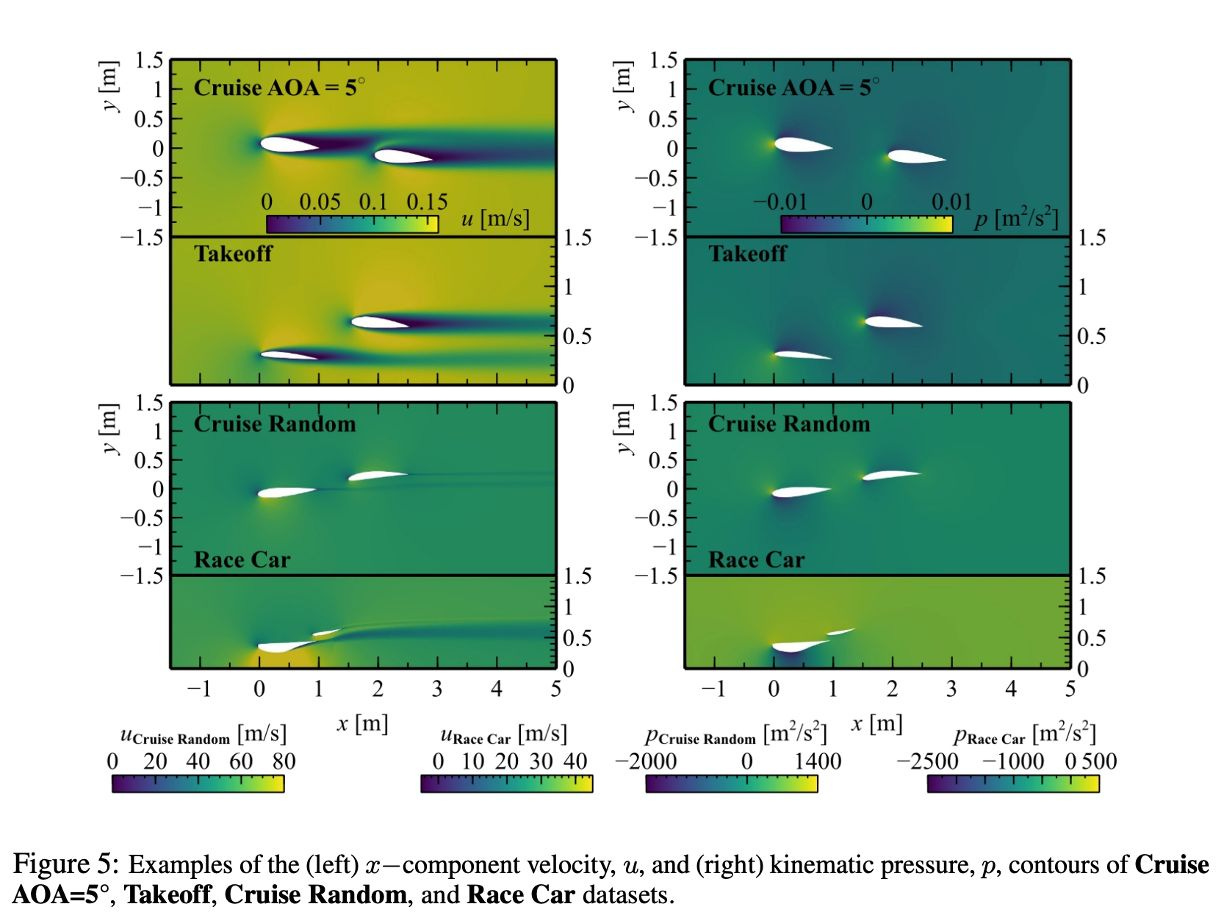
The paper accompanying the data is here: https://openreview.net/pdf?id=4Z0P4Nbosn
Huge thanks to the developers of this, Thomas Capelle and Morgan McGuire. Just reach out to chat if you want to learn how it works, get started yourself, or just to give some kudos for interesting stuff!
Overview.
To understand these projects, it helps to think of them not just as "software," but as the first steps toward automated science. In traditional research, a human scientist spends weeks coming up with an idea, writing code to test it, waiting for a computer to run the experiment, and then looking at the results to decide what to do next. Andrej Karpathy’s autoresearch and Weights & Biases’ senpai are designed to let AI agents take over that entire "guess-and-check" loop.
Autoresearch: The Tireless Lab Assistant
Karpathy’s autoresearch is like a minimalist, one-person laboratory. It treats the AI agent as a tireless researcher that never sleeps. You give it a specific goal (like “make this chatbot more efficient”) and a set of rules. The AI then enters a continuous loop: it writes a new version of the code, runs a quick 5-minute experiment, and checks the “score.” If the score improves, it keeps the change; if not, it throws the code away and tries something else.
The brilliance of this approach is its simplicity. By restricting every experiment to exactly five minutes, the AI is forced to find “quick wins” and iterate rapidly. It doesn’t get bored or distracted, allowing it to discover clever optimizations—sometimes overnight—that a human might have overlooked or been too tired to test.
Senpai: The Distributed Research Team
While autoresearch is a single assistant, senpai is an entire AI research organization. As we progressed this work at Weights & Biases, we realized that for truly complex problems—like designing wings for airplanes or predicting weather patterns—one assistant isn’t enough. You need a team.
Senpai introduces a “Manager and Worker” (Advisor/Student) hierarchy.
The Advisor: This is the “brain” of the operation. It doesn’t do the heavy lifting; instead, it looks at all the data, comes up with high-level strategies, and writes “assignments” in the form of GitHub Pull Requests.
The Students: These are the “hands.” Multiple Student agents live on different powerful computers (GPUs). They pick up the assignments, run the actual experiments, and report back to the Advisor with their findings.
The High-Level Value: Scaling Discovery
The real value of senpai is scalability and collaboration. Because the agents communicate using the same tools human developers use (like GitHub and Weights & Biases dashboards), humans can actually “peak into the lab” at any time. You can see the Advisor’s reasoning, watch the Students’ progress in real-time, and even step in to give the AI a hint if it gets stuck.
In short, where autoresearch proved that an AI can be a scientist, senpai proves that AI can be a research department. It allows companies to throw massive amounts of computing power at a problem and have an organized team of AI agents coordinate themselves to find the best solution as fast as possible.


